 1 Hour Startup
iPhone & iPad · Free
1 Hour Startup
iPhone & iPad · Free
New run · ship in 60 minutes
It plays like a game.It teaches like a year of it.It ends with a document you can build from.
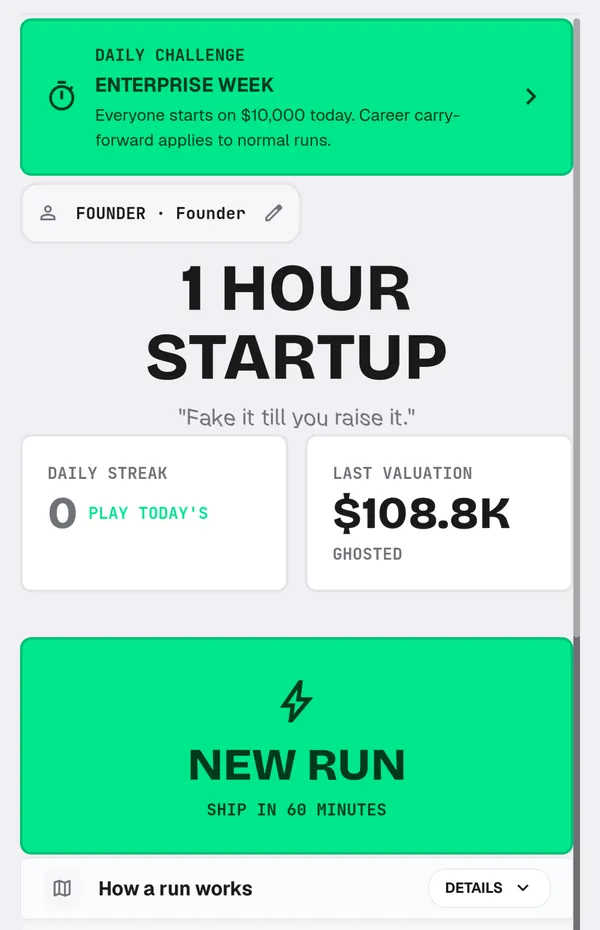
1 Hour Startup is a startup simulator for iPhone. You take one idea from a blank page to an investor's verdict in about an hour, and the questions on the way are the real ones — who the customer is, what happens to a trial account when it ends, what growth means when you are the one who has to define it. Answer them and the game hands you a product build specification. Paste that into Lovable, Replit or Bubble, and something gets built.
Free to play. No ads, no in-app purchases, nothing to buy. Nothing you could pay for would move ARR, burn, churn, hype, cash or your score, because there is nothing to pay for.
Different runs possible
4 × 10³⁸
a 4 followed by 38 zeros
Questions written121
Startup ideas107
Things that go wrong129
AI build tools31
Counted from the shipped content packs, not quoted from a press release —
data/ideas.json and data/content_packs/, at the build these screenshots came from. The
run count multiplies every question a run can be asked by the answers that question
offers, so it is a ceiling: some questions are only put to some players, and some answers
close others off.
Play · learn · build
One hour. A game, a course, and a first draft.
Most startup games stop at the score. Most startup courses never let you make a move. This one is a game you can lose, a course you never sit through, and a working draft of the company you had in your head — all from the same run.
Play
Play a company you can lose.
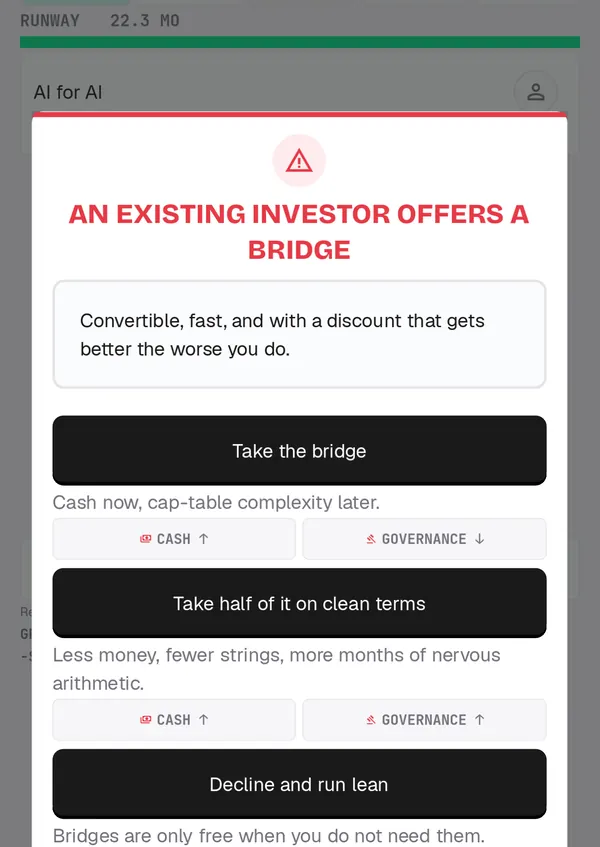
A clock, a bar that moves when you decide, and a deck of events that has not read your plan. A bridge round arrives on the day you least want it. Your best engineer has updated their profile. You pick, you pay, you keep going — and every run ends differently because you did.
There is a score, a leaderboard, and a next run that will not play the same.
Learn
Learn what a founder is actually asked.
Nobody lectures. Every question is one you would get from a customer, a co-founder, or the person across the table holding the term sheet: how big the team is at launch, who keeps board control, what “revenue” means when someone asks you to define it.
What an investor is looking at stops being a mystery, because you sat through the pitch.
Build
Build the thing for real.
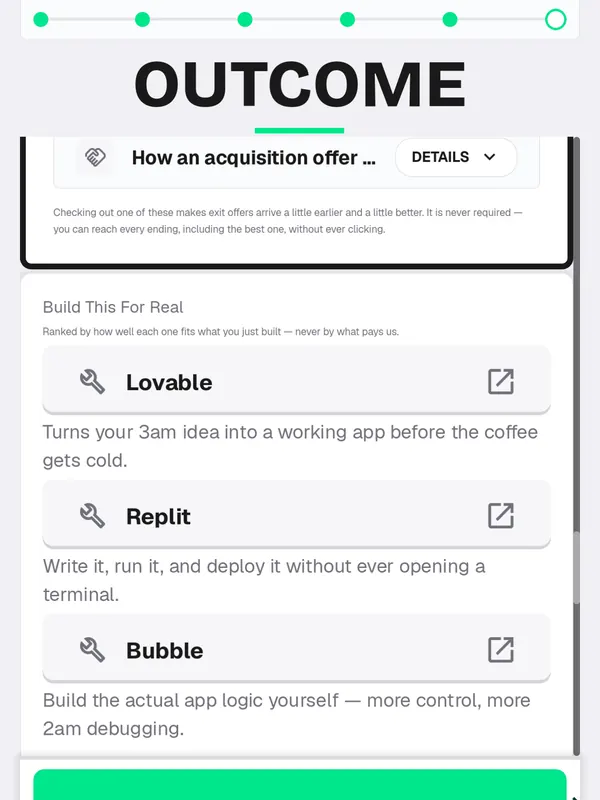
The run was taking notes the whole time. At the end it hands you a product build specification, ranks real build tools by how well each fits it, and lists the questions that tool will ask you next — so the hour you spent playing is the first hour of the real thing.
Your idea leaves the phone as a document a builder can start from.
Founder profile
An hour, and what is inside it
You are dealt a founder rather than allowed to design one — one of six archetypes, with the strengths and the gaps that come with it. Then you pick a market and an idea out of 107, and after that nobody asks you what kind of company you would like to have. They ask you what you are going to do on Tuesday.
Measured, four walks
62 screens. 59 of them you have to answer.
The app is named after a claim, so the claim is instrumented. A full pre-seed run drives 62 screens and 121 taps. Read only the screens you must answer, at an ordinary 200 words a minute, and the run lands a little over an hour — 63 minutes on the walk we measured.
That count moves with the market you choose, and the honest caveat is the one the instrument prints itself: the screens and taps are measured, the minutes are derived. A real median needs real people, and we do not have one yet.
The ladder
Eleven phases, and eleven ways it ends
Founder profile, problem validation, MVP, team and funding, growth, then the rounds: seed, series A, B, C, D and up, and unicorn — eleven in the shipped content. A company can finish as a unicorn, an IPO, an acquisition, an acqui-hire, an IP sale, a merger, a pivot, a founder exit, a profitable independent company, a sustainable small business, or a deliberate wind-down with money left to give back. Ten of those are not failure and one of them is the one most real companies actually reach.
MVP decisions
What you learn, and where you learn it
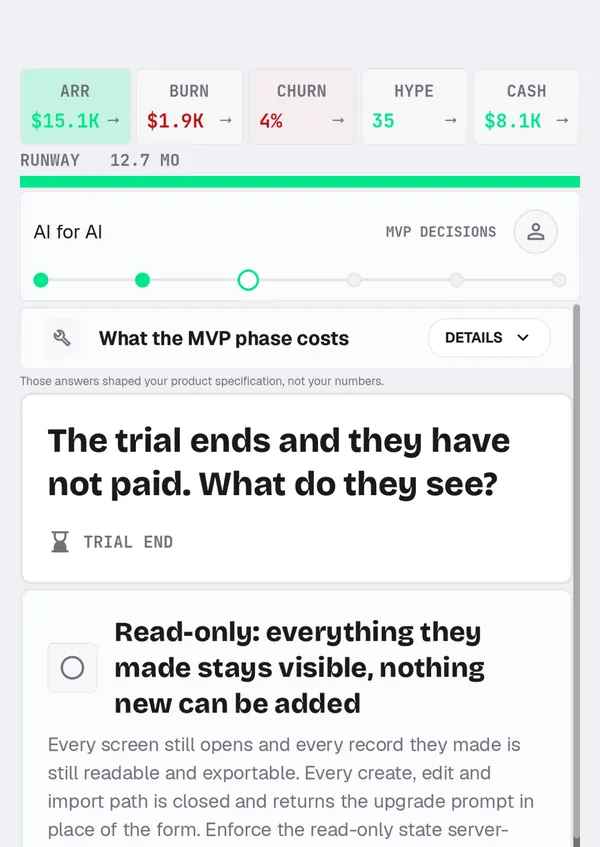
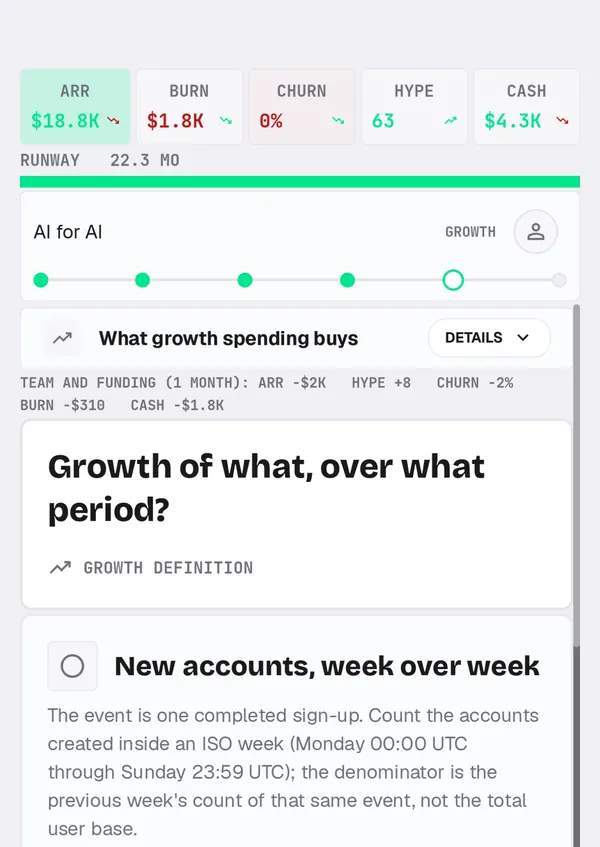
Nothing here is a lesson with a next button. There is no glossary and no lecture. What teaches is the question itself: it is specific, it has consequences you can see in the bar at the top of the screen, and there is no option that is quietly correct. 121 distinct questions exist across the eleven phases, holding 551 answers between them. One run is asked its own market's share of those questions, and multiplying each of them by the answers it offers is where the figure at the top of this page comes from.
What the hour teaches
Questions you will be asked, in the game's own words
These are real screens from the run, with the answers exactly as the game offers them. None of them has a hidden right choice. Each one moves a number you can see, and each one becomes a line in the document you leave with.
Team
“How many people build this, and who pays them?”
- Solo founder
- Solo + Contractors
Payroll is the fastest way to turn runway into a deadline. Here you feel it before you sign anything.
Sales
“Who closes deals, and what does that cost you?”
- Founder-Led Sales
- Fractional Sales Lead
- Small Sales Team
The first customers are usually closed by the founder. The game asks when that stops being true.
Governance
“Whose vote wins when you and your board disagree?”
- Keep Founder Control
- Dual-Class Shares
- Balanced Board
A term most founders meet for the first time in a lawyer's email. Here it is a decision, with a price attached.
Pricing
“Pricing approach”
- Test Pricing by Value & Segment
- Copy a Competitor's Price
- Price as Low as Possible
The cheapest option is also the one that closes the most doors later. The game lets you find that out for the cost of a run.
Market
“How wide is your market, and what does that cost you?”
- One narrow segment first, the next on the roadmap
- One Narrow Segment, and We Stay There
- Broad Market
What an investor means by “focus”, asked as a choice rather than given as advice.
Validation
“Now that you’ve researched it, what’s next?”
- Talk to Customers First
- Design Partner Pilot
- Landing Page Smoke Test
Every founder says they validated. This screen asks what you actually did.
Metrics
“Revenue of what, recognised when?”
- Cash actually collected in the period
- Recurring revenue on the books at period end
- Value of contracts signed in the period
The number in your pitch depends on which one you picked. So does whether the investor believes it.
Fundraising
“Where does the cash come from, and who gets a say?”
- Bootstrap
- Friends & Family Round
- Grants & Competitions
Money arrives with a shape. The game shows you the shape before you take it.
Valuation
“Valuation approach”
- Fundamentals-Based Valuation
- Whoever Pays the Highest Price
- Copy a Competitor's Multiple
Late in a run, when it matters. By then you know what each answer costs the people who were there early.
The pitch
What an investor is actually looking at
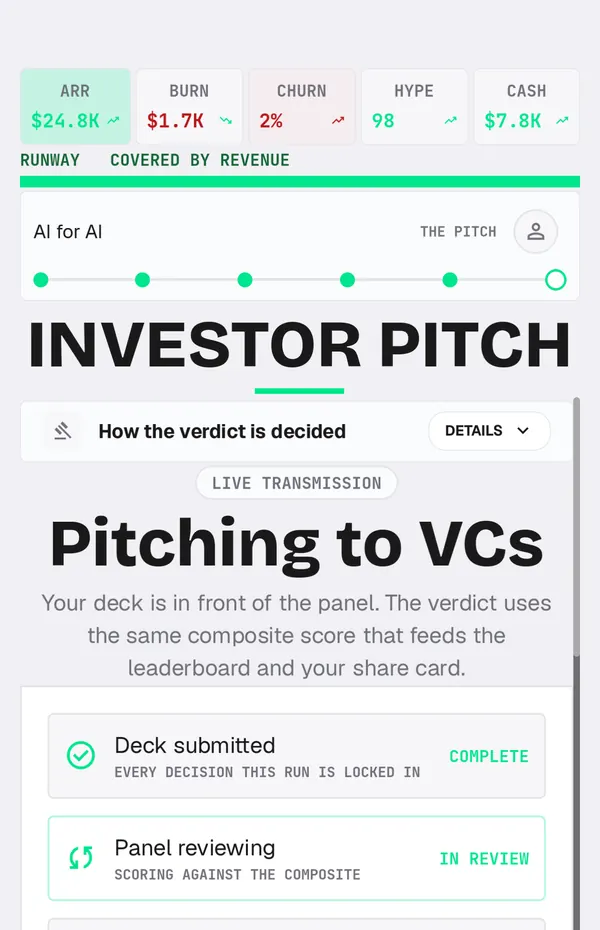
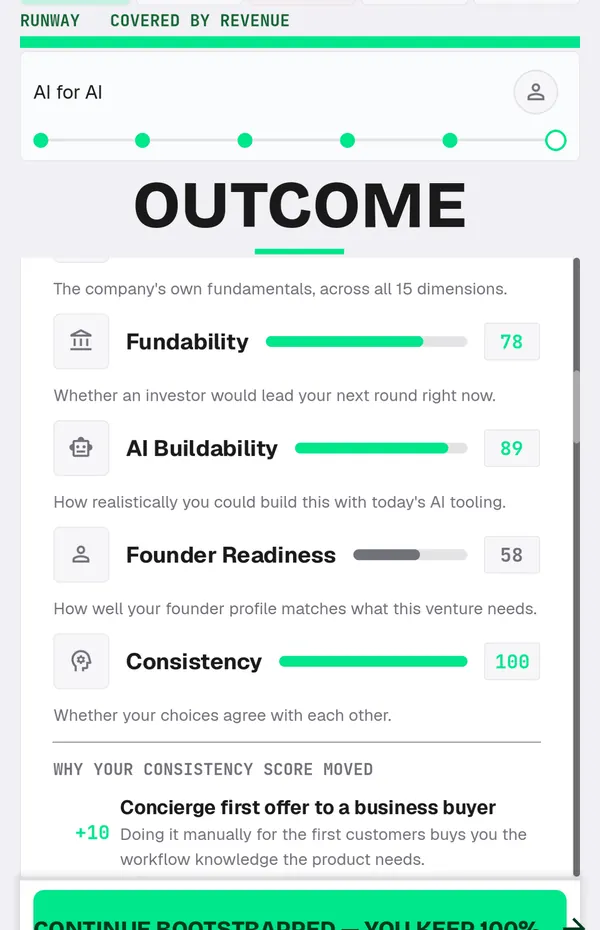
At the end of the run you pitch, and the verdict is not a mood. Underneath it sits a scorecard: fifteen dimensions of the company you built, each computed from decisions you made an hour of game-time earlier. The screen shows you the scores, then shows you which choice moved one of them and by how much. That is the part no pitch-deck feedback ever gives you.
- Problem Evidence
- Customer Clarity
- Founder-Market Fit
- Product Evidence
- PMF
- Revenue Evidence
- GTM Repeatability
- Unit Economics
- Team & Leadership
- Capital Efficiency
- Moat
- Governance & Risk
- Expansion
- Integrity
- Unicorn Momentum
Build this for real
What you walk out holding
This is the part that is not a game. Every answer you gave was also being written down, and at the end the run compiles into a product build specification — twelve sections, laid out for a builder: product context, business model, MVP scope, user journeys, functional requirements, data model, AI capabilities, integrations, UX requirements, security and compliance, analytics, acceptance criteria. Copy it, or save it as a PDF.
How the document opens
The first words of every specification the game produces.“I came here from 1 Hour Startup, and I have an idea I believe in.
This is not a sketch I wrote in one sitting. It is the record of a run through that game: a long series of decisions, made one question at a time, with the trade-offs in front of me. Every line below either traces back to something I answered, or says plainly that it does not.”
The limit, said first
The game does not build your app
It writes the brief. The building is done by a tool you choose, and it will ask you things this document cannot answer. Where an answer was never captured, the specification says [NOT CAPTURED] and tells the builder to derive it and label what it derived — rather than inventing a fact and presenting it as yours.
Eight build targets are supported, and the document is reordered and re-worded for whichever one you pick:
- Lovable
- Replit Agent
- Bolt
- Bubble
- Webflow
- v0
- Backend / API
- Database schema
You have an idea. Give it an hour.

iPhone and iPad. No account, no password, no email — the app signs in anonymously and never asks who you are.